The Temptation at the Edge of the Table
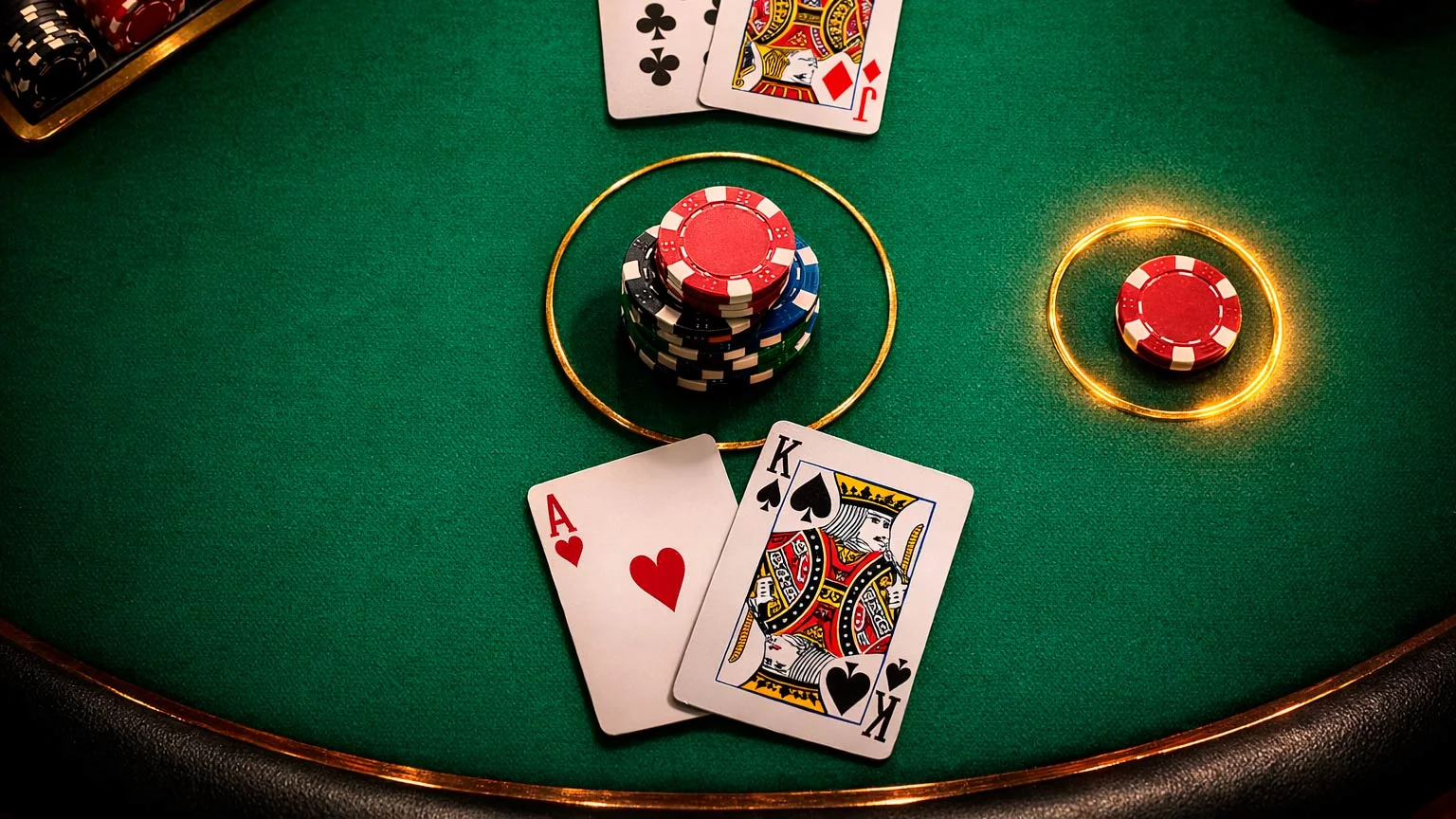
Side bets sit in a small circle next to your main wager, offering payouts that the base game cannot match — 25:1 on a suited pair, 100:1 on a perfect three-card hand, sometimes even higher on exotic combinations. They are the flashiest feature on a sweepstakes blackjack table, and they are almost universally terrible bets from a mathematical perspective. The house edge on common side bets ranges from 3% to over 10%, compared to the 0.3% to 0.5% on the main blackjack hand played with optimal basic strategy, according to Wizard of Odds.
That gap is not subtle. A player making 1 SC side bets alongside 1 SC main bets is effectively doubling their per-round exposure while dramatically increasing the overall house edge on their total wager. The main hand costs roughly 0.005 SC in expected loss. A side bet with a 5% edge costs 0.05 SC — ten times more per unit wagered. Over 200 rounds, the side bet alone drains 10 SC, while the main game costs just 1 SC. The side bet is not a supplement to your blackjack session; it is a separate, much worse game running in parallel.
Understanding which side bets exist at sweepstakes tables, what they actually cost, and when (if ever) they make sense requires looking at the math without the distraction of the payout tables that make them seem exciting.
Common Side Bets and Their House Edges
The side bets available at sweepstakes blackjack tables vary by provider and platform, but several appear frequently enough to warrant specific analysis.
Perfect Pairs pays when your first two cards form a pair. Mixed-color pairs typically pay 5:1, same-color pairs 10:1, and suited pairs (same suit, same rank) 25:1 or 30:1. The house edge on Perfect Pairs ranges from 4% to 8% depending on the specific paytable and number of decks. On a six-deck game, the probability of receiving any pair on your first two cards is about 7.7%, and the probability of a suited pair is roughly 1.7%. The large payouts on suited pairs look attractive until you realize that 92% of the time, you lose the entire side bet instantly.
21+3 combines your first two cards with the dealer’s upcard to form a three-card poker hand. Flush, straight, three-of-a-kind, straight flush, and suited three-of-a-kind all pay at escalating rates, with top payouts sometimes reaching 100:1. The house edge on 21+3 typically sits between 3% and 7%. The bet adds a layer of interest to the deal because you are evaluating a poker hand alongside your blackjack hand, but the interest comes at a steep mathematical price.
Insurance is technically not a side bet in the traditional sense, but it functions as one. When the dealer shows an ace, you can place an insurance wager equal to half your main bet, which pays 2:1 if the dealer has blackjack. The house edge on insurance is approximately 7.4% in a standard six-deck game — one of the worst wagers available at any blackjack table. Basic strategy is unambiguous on this point: never take insurance. In a physical casino, card counters occasionally take insurance when the deck is sufficiently rich in ten-value cards, but this logic is completely irrelevant at sweepstakes tables running RNG, where every hand draws from a fresh virtual deck. The insurance bet is a pure negative-EV proposition in the sweepstakes context, without exception.
Bet Behind, where available, lets you wager on another player’s hand at live dealer tables. The house edge depends on how well the other player executes basic strategy. If they play optimally, your edge is the same as theirs. If they play poorly, your edge is worse. Since you cannot control another player’s decisions, Bet Behind introduces uncontrollable variance into your session — a risk that offers no compensating advantage.
The Variance Trap: Why Side Bets Feel Better Than They Are
Side bets exploit a well-documented cognitive bias: humans overweight rare, large payouts relative to frequent, small losses. A 25:1 payout on a suited pair registers as exciting and memorable. The 24 consecutive rounds where the side bet lost 1 SC each time barely register at all. Over those 25 rounds, the player has wagered 25 SC on the side bet, won 25 SC once, and lost 24 SC — for a net loss of zero if the payout is exactly 25:1, or a net loss if the payout is lower (which it usually is, once you account for the probability distribution across different pair types).
The variance profile of side bets is dramatically higher than the main blackjack hand. Standard deviation per unit on Perfect Pairs is roughly 3 to 4 times that of a base blackjack bet. This means your balance swings more violently per round when side bets are active, which can create the illusion of a more exciting — and potentially more rewarding — session. In reality, the excitement is generated by variance, not by favorable odds. You are paying a premium for bigger swings, not for better expected outcomes.
For players who enjoy the entertainment value of side bets and are willing to pay the mathematical premium, there is no moral failing in placing them occasionally. The key is sizing: if you are betting 1 SC on the main hand, a 0.10 SC side bet adds negligible expected cost to your session (0.005 SC per round at a 5% edge). A 1 SC side bet alongside a 1 SC main bet, by contrast, roughly doubles your effective house edge for the round. Keep side bets small relative to your main wager, and the damage is contained.
When Side Bets Might Make Sense — and When They Never Do
There are precisely two scenarios where side bets can be justified without abandoning mathematical discipline. First, during Gold Coin play — when the side bet costs nothing of value, and you are purely exploring the format for entertainment. Second, when a promotional event specifically boosts side bet payouts to a level that reduces the house edge to something tolerable, which happens occasionally at sweepstakes casinos running short-term events.
Side bets never make sense when you are grinding Sweeps Coins with a goal of reaching a redemption threshold. The math is straightforward: every SC spent on a side bet has three to twenty times the expected loss rate of the same SC spent on the main hand. If your objective is to play the most hands for the least cost — the rational approach for any SC-focused session — side bets are the single most expensive option on the table. Even a modest side bet habit can erode your bankroll faster than a full bet-size increase on the main game.
The general rule: treat side bets as what they are — premium entertainment features with a built-in surcharge. Use them when playing for fun with Gold Coins. Skip them when playing for value with Sweeps Coins. And never let the occasional 25:1 hit convince you that the bet is profitable. It is not. The house edge ensures it never will be.
If you find yourself drawn to side bets for the excitement they provide, consider whether increasing your main bet by the same amount would deliver a comparable experience at a fraction of the mathematical cost. A 2 SC main bet carries the same variance increase as adding a 1 SC side bet — but the expected loss on the additional 1 SC main bet at 0.5% edge is 0.005 SC, versus 0.05 to 0.10 SC on a side bet at 5-10% edge. You get bigger swings for the same money, without paying the side bet premium. The main game is already exciting when the stakes are right. Side bets are a solution to a problem that bet sizing solves more cheaply.
The wider context is set out in our sweepstakes blackjack guide.