The Legal Pillar That Holds Up the Entire Model
Every sweepstakes casino in the United States depends on a single legal concept for its existence: AMOE, or Alternative Method of Entry. Without it, the sweepstakes model collapses into gambling. With it — at least according to the industry’s legal argument — platforms can offer games of chance with cash prizes without triggering state gambling laws. Understanding AMOE is not optional for anyone trying to make sense of sweepstakes blackjack. It is the foundational mechanism that separates what these platforms do from what a licensed online casino does.
Traditional gambling requires three elements: consideration (something of value paid by the player), chance (a random outcome), and prize (something of value received by the winner). Remove any one element, and the activity falls outside most state gambling definitions. Sweepstakes casinos target consideration. By offering a free method to obtain Sweeps Coins — the prize-eligible currency — they argue that no purchase is necessary, and therefore no consideration exists. As Magnus Boberg of JustGamblers has explained, sweepstakes platforms bypass the regulations applied to traditional gambling because they do not require payment to participate.
The legal reality is more contested than the theory suggests. Six states banned sweepstakes casinos in 2025, and over 100 cease-and-desist orders were issued by attorneys general across the country, according to Gambling Insider. Much of the regulatory pushback targets AMOE specifically — arguing that the free entry mechanism is so impractical that it functions as a legal fiction rather than a genuine alternative.
How AMOE Works in Practice
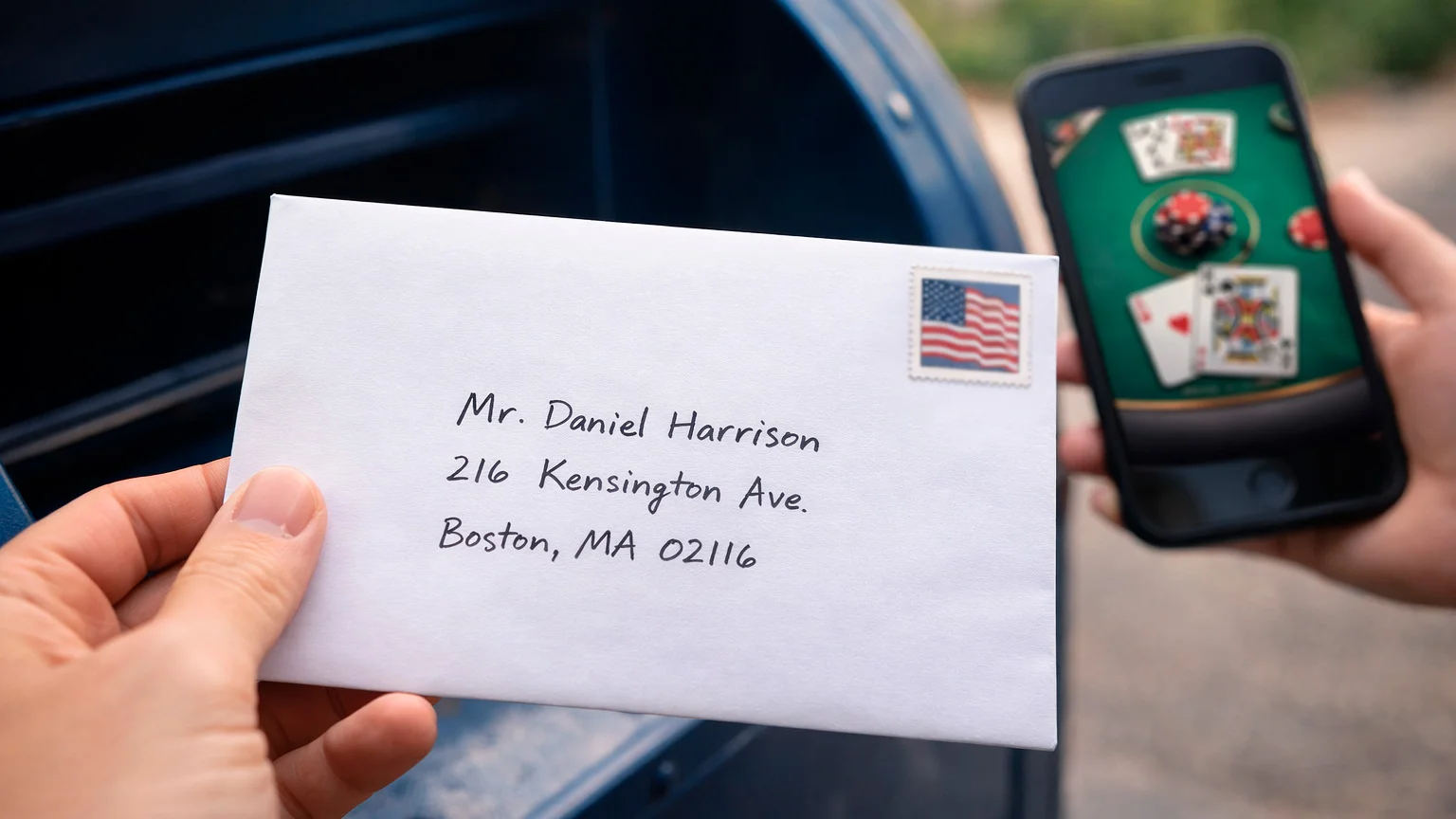
The most common AMOE method is mail-in entry. Sweepstakes casinos publish a physical mailing address — typically a P.O. box — where players can send a handwritten request for free Sweeps Coins. The request must include specific information: your name, address, the platform’s name, and sometimes a particular phrase or reference code. The casino then credits your account with a small allotment of SC — commonly 5 to 10 coins — within a processing period that can range from a few days to several weeks.
The mail-in process is deliberately slow and low-yield. A player requesting 5 SC through the mail is receiving the equivalent of roughly $5 in potential prize value, minus the cost of a stamp, an envelope, and the time spent writing and mailing the request. Compare this to purchasing a $9.99 Gold Coin package that instantly delivers 20 or 30 SC alongside millions of GC, and the economic incentive to use AMOE becomes negligible for most players.
Some platforms supplement mail-in entry with digital AMOE methods: daily login bonuses that grant 0.20 to 0.50 SC, social media giveaways tied to promotional events, or periodic SC drops during specific holidays. These methods provide free SC without requiring physical mail, but the amounts remain small — designed to meet the legal threshold of “no purchase necessary” rather than to provide a functionally equivalent alternative to purchasing.
A handful of platforms have experimented with more generous AMOE structures. Some offer onboarding SC bonuses that give new accounts a meaningful starting balance without any purchase. Others provide daily challenge systems where completing tasks — playing a set number of GC hands, logging in on consecutive days — earns SC rewards. These more robust free-entry systems are a relatively recent development, driven in part by the legal pressure questioning whether minimalist AMOE programs truly satisfy the “no purchase necessary” requirement.
The Legal Debate: Is AMOE a Real Alternative or a Legal Fiction?
The core legal question is straightforward: does the existence of a free entry method genuinely eliminate consideration from the sweepstakes equation, or is it a fig leaf that allows platforms to operate as de facto gambling operations while maintaining a technical defense?
The industry’s position is that AMOE is legally sufficient regardless of how many players use it. The argument draws on decades of promotional sweepstakes law: McDonald’s Monopoly does not become illegal gambling simply because most participants buy food rather than requesting free game pieces by mail. The free entry path exists, and its existence is what matters, not its utilization rate.
Critics — including state attorneys general, the AGA, and plaintiffs in class action lawsuits — counter that context matters. A fast-food promotion where the prize is incidental to the purchase of a hamburger is fundamentally different from a platform where the entire product is built around games of chance with cash prizes. The fact that only about 12% of sweepstakes casino users ever make a purchase, according to RG.org, does not mean that 88% are using AMOE — many are playing with GC that has no cash value. The question is whether the purchase-to-SC pathway functions as the primary access route for prize-eligible play, rendering AMOE ornamental rather than functional.
Courts have not yet issued definitive rulings on this question at the federal level. State-level outcomes have varied. California’s AB 831 sidestepped the AMOE debate entirely by defining the prohibited activity in terms of the dual-currency model itself rather than the presence or absence of a free entry mechanism. Other states may follow similar approaches, which would make the legal viability of AMOE moot in those jurisdictions regardless of how robust the free entry program is.
The trajectory is not encouraging for AMOE defenders. Every state ban enacted in 2025 either explicitly rejected the AMOE defense or drafted language that rendered it irrelevant. The cease-and-desist orders issued by attorneys general in Arizona, Michigan, Louisiana, and other states similarly treated the free entry mechanism as insufficient to overcome the gambling classification. While AMOE has not been definitively struck down by a court of final jurisdiction, the regulatory and legislative consensus is moving against it with a speed and consistency that suggests the defense is weakening rather than strengthening.
What AMOE Means for Blackjack Players
For individual players, AMOE is primarily a source of free Sweeps Coins — modest but real. If you are willing to invest the time and effort, mail-in requests and daily login bonuses can build a small SC bankroll over weeks without any financial outlay. This is useful for players who want to experience SC blackjack at minimal cost, though the amounts are typically too small for extended strategic play. A mail-in request yielding 5 SC gives you perhaps 50 hands at a 0.10 SC minimum bet — enough to get a feel for the game but not enough for meaningful bankroll management or strategy testing over a statistically significant sample.
The practical approach for most players is to use AMOE as a supplement rather than a primary SC source. Claim daily login bonuses, submit periodic mail-in requests, and treat the accumulated free SC as a small buffer that extends your paid balance. Some players maintain a strict AMOE-only approach for philosophical or budgetary reasons, and the model does allow this — it simply requires patience and low bet sizes that many players find unsatisfying.
More importantly, AMOE’s legal status determines the continued existence of sweepstakes blackjack as a product category. If courts or legislators conclude that AMOE does not genuinely eliminate consideration, the entire sweepstakes model loses its legal foundation. That does not mean individual players face legal risk — AMOE lawsuits target operators, not users — but it does mean that the platform you play on could cease to exist in your state with relatively little warning. The legal ground beneath sweepstakes casinos is shifting, and AMOE is the fault line where the pressure concentrates. For players, the takeaway is practical: enjoy sweepstakes blackjack while it is available, redeem your SC regularly rather than accumulating large balances, and understand that the free-entry mechanism keeping the industry alive is facing the most serious legal challenges in its history.
The wider context is set out in our sweepstakes blackjack guide.
The two currencies it feeds are in Gold Coins and Sweeps Coins.