
Blackjack Is Simpler Than You Think
Blackjack is the most popular table game in both physical and online casinos for a reason: the rules are simple enough to learn in five minutes, but the strategy runs deep enough to reward years of study. At sweepstakes casinos, the game plays identically to its real-money counterpart — same card values, same decisions, same mathematical principles. The only difference is the currency: Gold Coins for practice, Sweeps Coins for prize-eligible play.
If you have never played blackjack before, a sweepstakes casino is an ideal starting point. You can learn the game with Gold Coins at zero financial risk, practice until you are comfortable with the decisions, and transition to Sweeps Coins whenever you feel ready. Over 55 million Americans engage with sweepstakes gaming annually, according to Lineups.com, with roughly 58% of users falling in the 25-to-44 age bracket — and a significant share of them are encountering table games like blackjack for the first time through these platforms.
Card Values: The Foundation of Every Decision
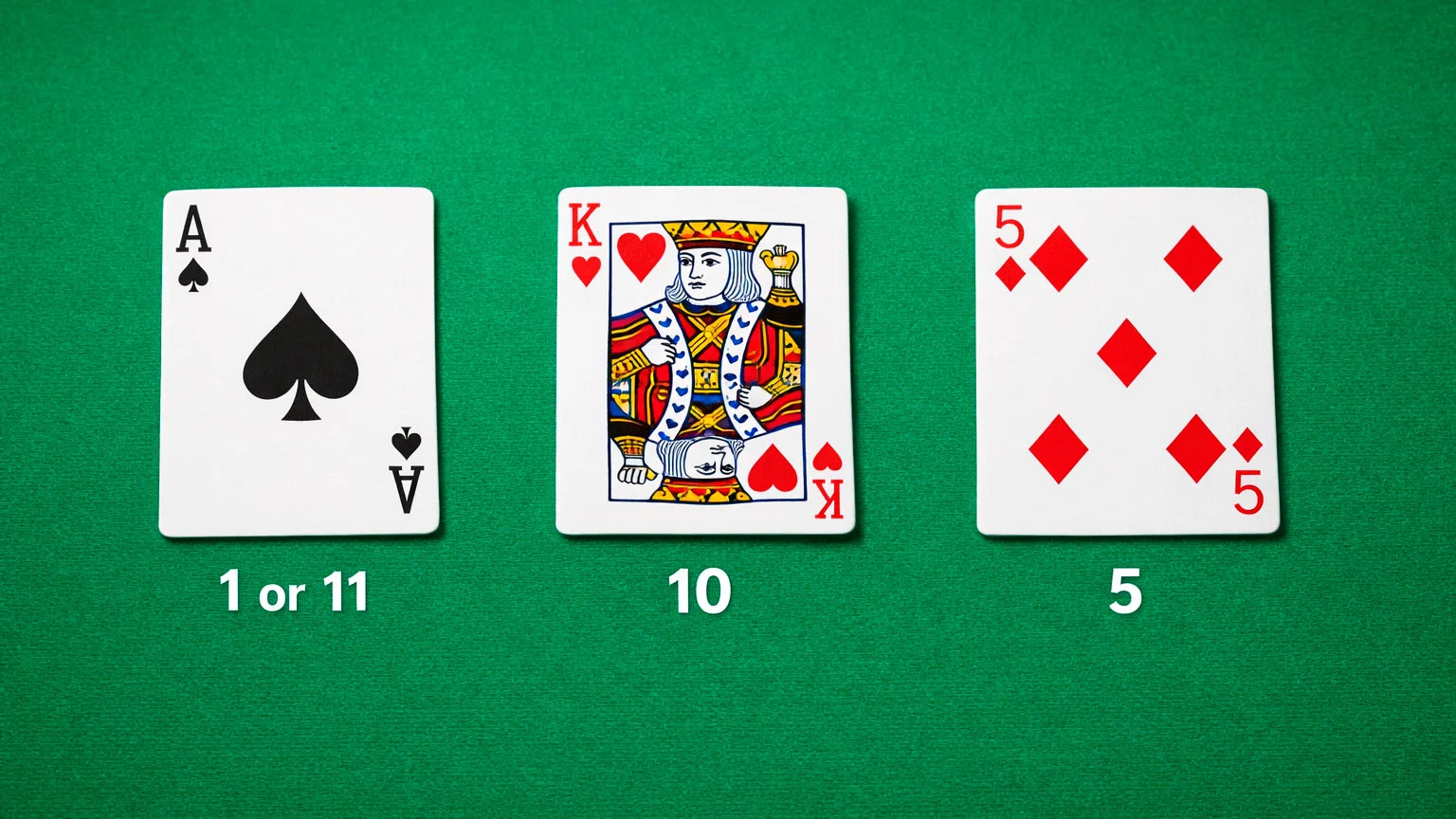
Every card in blackjack has a fixed point value. Number cards (2 through 10) are worth their face value. Face cards — Jack, Queen, King — are each worth 10 points. Aces are worth either 1 or 11, whichever benefits your hand more. A hand containing an Ace counted as 11 is called a “soft” hand because it can absorb another card without busting. A hand without an Ace (or where the Ace must count as 1 to avoid exceeding 21) is a “hard” hand.
The suit of the card is irrelevant in standard blackjack. A King of hearts and a King of spades are both worth 10. This is different from poker, where suits matter for flushes and other hand rankings. In blackjack, only the point total counts.
The most valuable starting hand is a natural blackjack: an Ace plus any 10-value card (10, Jack, Queen, or King) dealt as your first two cards. This hand totals 21 and usually pays 3:2 — meaning a 1 SC bet returns 2.50 SC (your original bet plus 1.50 SC in winnings). Some tables pay 6:5 on naturals, which is significantly worse for the player — the difference adds roughly 1.4% to the house edge. Checking the blackjack payout before choosing a table is one of the most important decisions you will make, and it takes about two seconds.
A few examples to build intuition: a hand with a 7 and a 9 totals 16 — a weak hand that is dangerous to hit (any card above 5 causes a bust) but also risky to stand on (the dealer will beat 16 more often than not). A hand with an Ace and a 6 totals soft 17 — you can safely hit because the Ace can drop from 11 to 1 if the next card would otherwise bust you. A hand with two 8s totals 16 and should always be split into two separate hands, each starting from 8. These specific scenarios will come up repeatedly, and knowing the correct play for each one before it appears on screen is what separates strategic play from guesswork.
Walking Through Your First Hand
You place your bet by selecting a chip denomination and clicking the betting circle. The game deals two face-up cards to you and two cards to the dealer — one face-up, one face-down (the “hole card”). Your goal is to get closer to 21 than the dealer without going over. If your total exceeds 21, you bust and lose immediately, regardless of what the dealer has.
After seeing your cards and the dealer’s upcard, you choose an action. Hit means you take another card. You can hit as many times as you want, as long as your total stays at or below 21. Stand means you keep your current total and pass the action to the dealer. Double Down means you double your original bet, receive exactly one more card, and then stand automatically — this is used when your hand is strong and the dealer’s upcard is weak. Split is available when your first two cards are a pair. You separate them into two independent hands, place an equal bet on the second hand, and play each one separately.
Once you finish your actions, the dealer reveals their hole card and plays according to fixed rules. The dealer must hit on 16 or below and stand on 17 or above (though some tables require the dealer to hit on “soft 17” — a hand containing an Ace counted as 11 plus a 6). The dealer has no choices to make; their play is entirely mechanical. If the dealer busts, all remaining player hands win. If the dealer does not bust, the higher total wins. A tie (called a “push”) returns your bet with no gain or loss.
The Dealer’s Rules: Why the House Has an Edge
The dealer’s advantage comes from one structural asymmetry: you act first. If you bust, you lose immediately — even if the dealer would have also busted on the same hand. This “double bust” scenario is impossible because the player’s bust is resolved before the dealer draws. It is the single biggest source of the house edge, and it is why blackjack strategy exists: every decision you make is an attempt to navigate this asymmetry as efficiently as possible.
The dealer’s mechanical rules — forced to hit below 17, forced to stand at 17 or above — mean the dealer’s behavior is entirely predictable. This predictability is what makes basic strategy possible. Since you know exactly how the dealer will play every hand, you can calculate the mathematically optimal response to every combination of your cards and the dealer’s upcard. A basic strategy chart is essentially a cheat sheet derived from these calculations, and using one correctly reduces the house edge to between 0.3% and 0.5%, according to Wizard of Odds.
For your first several sessions, playing with a basic strategy chart open on a second device (or printed beside your computer) is not just acceptable — it is recommended. The chart tells you the correct play for every possible hand. Over time, the most common decisions become automatic: always split aces and eights, never split tens, always double 11 against a dealer 6. But until that muscle memory develops, the chart is your safety net. There is no penalty for consulting it at a sweepstakes table — the RNG does not care how long you take to decide, and Gold Coin tables impose no time pressure on your learning curve.
One mistake beginners commonly make is taking insurance when the dealer shows an Ace. The insurance bet pays 2:1 if the dealer has blackjack, but the house edge on this wager is approximately 7.4% — making it one of the worst bets available at the table. Basic strategy says to decline insurance every single time in an RNG game. Another common error is standing on soft hands (like Ace-6 for soft 17) when hitting is the correct play. Soft hands are safe to hit because the Ace can adjust downward, and standing on soft 17 against a strong dealer upcard is one of the most costly beginner mistakes in terms of expected value lost per hand.
Start with Gold Coins. Play 100 hands with the strategy chart in front of you. Notice which decisions feel uncomfortable — those are the ones worth studying. Then play 100 more. By the time you have played 300 to 500 hands, you will be making correct decisions on 90% or more of hands without needing the chart, and the remaining 10% will be the edge cases that even experienced players occasionally need to look up. At that point, you are ready for Sweeps Coins — not because you have eliminated all errors, but because you have reduced them to the point where the remaining cost is negligible relative to the entertainment value of the game.
The wider context is set out in our sweepstakes blackjack guide.