

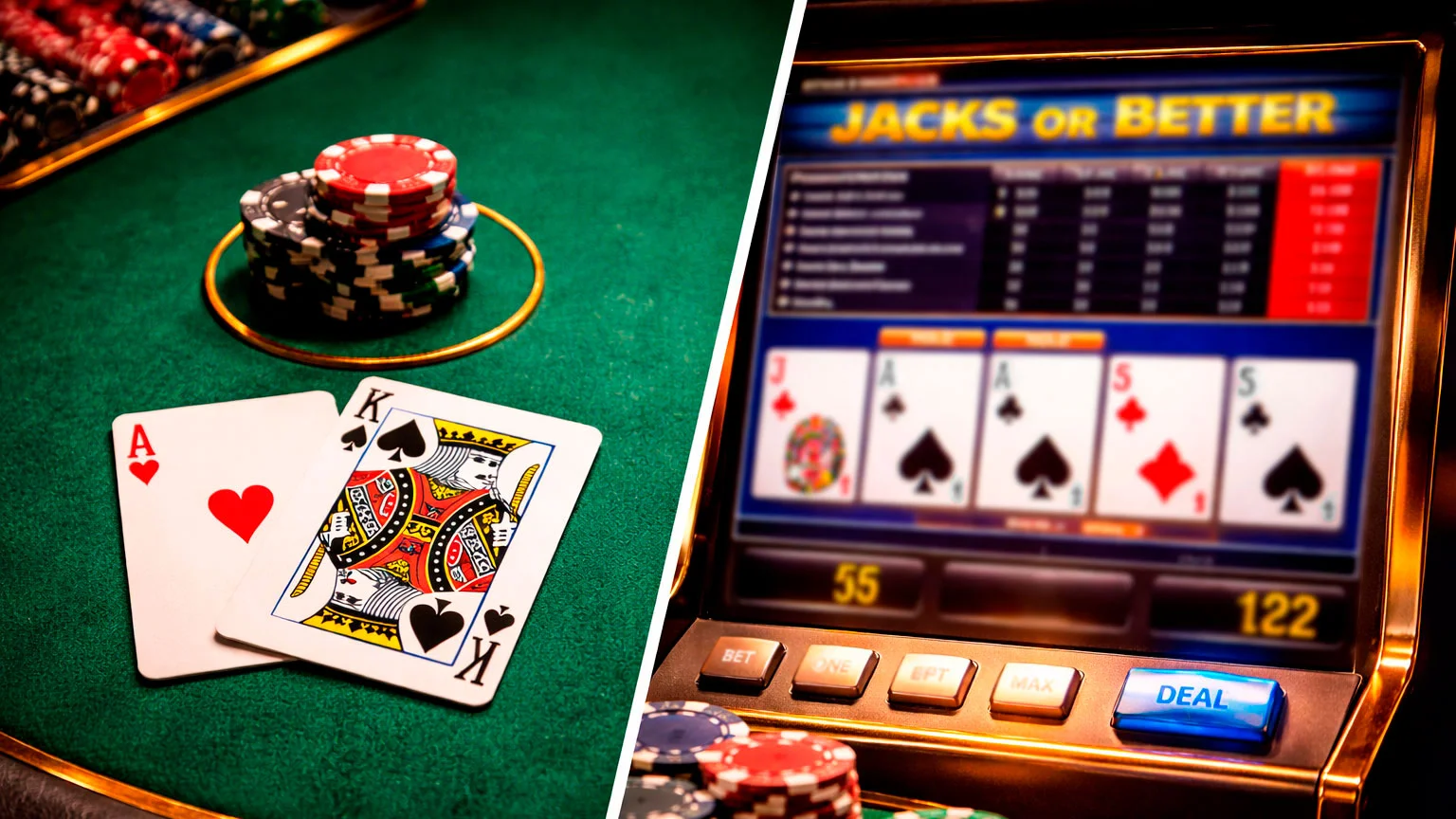
Two Games Where Decisions Actually Matter
In a sweepstakes casino lobby dominated by slot machines — where the only decision is how much to bet and when to press spin — blackjack and video poker stand out as the two games where player skill genuinely affects the outcome. Both reward strategic play with lower house edges. Both punish careless decisions with higher expected losses. And both operate on RNG engines that make every hand independent of the last, eliminating advantage techniques that work in physical casinos.
The comparison is worth making because these games compete for the same player: someone who wants more engagement than slots provide, who believes skill should influence results, and who is looking for the best return on their Sweeps Coins. Choosing between blackjack and video poker at a sweepstakes casino is a meaningful decision that affects your hourly cost, your variance exposure, and the nature of the strategic challenge you face.
Edge Comparison: House Advantage Head to Head
Blackjack with optimal basic strategy carries a house edge of 0.3% to 0.5%, depending on the specific rule set, according to Wizard of Odds. The best sweepstakes blackjack variant — Multihand at 99.62% RTP — delivers a 0.38% edge. Classic Blackjack typically runs at 0.78%, and Gravity at 0.71%.
Video poker’s house edge varies more dramatically by variant. Full-pay Jacks or Better (9/6 pay table) offers a house edge of approximately 0.46% with optimal strategy — competitive with the best blackjack tables. Full-pay Deuces Wild can theoretically deliver a 0.76% edge, while some Double Bonus variants approach 0.28%. However, the key phrase is “full-pay.” Many sweepstakes casinos offer reduced pay tables — 8/5 Jacks or Better instead of 9/6, for example — which pushes the house edge above 2%. The difference between full-pay and short-pay video poker is larger than the difference between the best and worst blackjack variants, making pay table verification absolutely essential before committing SC to a video poker machine.
Variance is another differentiator. Blackjack has a standard deviation of roughly 1.15 units per hand — relatively low, producing steady, predictable session results. Video poker variance is significantly higher, typically 4 to 6 units per hand depending on the variant, because a substantial portion of the game’s return comes from rare high-paying hands (four-of-a-kind, straight flush, royal flush). This means video poker sessions are more streaky: longer dry spells punctuated by occasional large payouts. A blackjack player with a 100 SC bankroll can expect smooth, gradual results. A video poker player with the same bankroll will experience wider swings and may need a larger buffer to avoid running out during a cold stretch.
In practice, the edge comparison favors whichever game the platform has implemented with the most favorable rules. A sweepstakes casino offering Multihand Blackjack at 99.62% and 8/5 Jacks or Better at ~97% makes blackjack the clear choice. A platform with a full-pay 9/6 Jacks or Better and a restrictive blackjack variant at 99.0% tilts the math toward video poker. Check the pay tables before making assumptions.
Strategy Depth: Different Kinds of Skill
Blackjack strategy is interactive. Your decisions depend on two pieces of information that change every hand: your card total and the dealer’s upcard. A basic strategy chart covers roughly 270 unique player-hand-versus-dealer-upcard combinations. Learning the chart requires memorizing the correct action for each combination — hit, stand, double, split, or surrender. The skill is in consistent execution: making the right play every time, even when it feels counterintuitive (hitting a hard 12 against a dealer 2, for example, or splitting 8s against a dealer 10).
Video poker strategy is comparative. You are dealt five cards and must decide which to hold and which to discard, drawing replacements for the discards. The correct play depends on evaluating all possible hold combinations against the pay table’s specific payouts. Full-pay Jacks or Better has approximately 40 strategic rules to memorize, covering scenarios from obvious (hold a dealt royal flush) to subtle (hold a low pair over a four-to-a-flush in certain configurations).
Both games reward study and punish guesswork. A blackjack player who does not know basic strategy faces a house edge of 1.5% to 2% — three to four times the optimal rate. A video poker player who discards incorrectly on complex hands similarly gives back percentage points. The strategic depth is comparable in terms of time to learn, though the nature of the skill differs: blackjack is about reading two variables against a matrix, while video poker is about evaluating hold combinations against a payout structure.
Availability at Sweepstakes Casinos
Blackjack enjoys significantly better availability across sweepstakes platforms. Virtually every sweepstakes casino with a table game section offers at least one blackjack variant, and many offer three to five options (Classic, Multihand, Gravity, Speed, European). The game is a standard inclusion in both ICONIC21’s and Playtech’s sweepstakes-licensed suites.
Video poker is less consistently available. Some sweepstakes casinos include Jacks or Better or Deuces Wild in their game lobbies; others omit video poker entirely. When it is available, the selection is typically thinner — one or two variants compared to blackjack’s broader lineup. Pay tables at sweepstakes casinos tend to be less favorable than what regulated online casinos offer, partly because sweepstakes operators face no regulatory requirement to publish or maintain specific pay tables. A player accustomed to 9/6 Jacks or Better at a regulated site may find only 8/5 or 7/5 versions at sweepstakes platforms, which transforms a competitive edge into a mediocre one.
The pace of play also differs between the two games and should factor into your decision. Video poker plays faster than blackjack in most implementations — 400 to 600 hands per hour is typical for a fast video poker player, compared to 200 to 300 for RNG blackjack. At the same house edge and bet size, faster play means higher hourly expected loss. A video poker player at 0.5% edge and 500 hands per hour loses 2.5 SC per hour at 1 SC bets, while a blackjack player at the same edge and 200 hands per hour loses 1.0 SC. If hourly cost control matters — and for SC players it should — the slower pace of blackjack provides a natural brake that video poker does not.
An EKG survey found that entertainment value and excitement were cited more frequently than winning real money as motivations for sweepstakes play, according to data from the SPGA. Both blackjack and video poker deliver more of that engagement than slots, but blackjack’s wider availability and more familiar format give it a practical edge for most sweepstakes players. If your platform offers both with favorable rules, alternating between them provides variety without sacrificing expected return. If only one is available with a good pay structure, choose that one and skip the inferior option — a 0.5% blackjack table is always better than a 2.5% short-pay video poker machine, regardless of personal preference.
The bottom line: both games reward the same core trait — willingness to learn and consistently execute correct strategy. If you enjoy the interactive, hand-by-hand decision-making of blackjack, it is the superior choice at most sweepstakes casinos due to better availability and more predictable session results. If you prefer the puzzle-like evaluation of hold combinations in video poker and can find a full-pay machine, the edge is competitive and the experience is equally rewarding. The worst choice is neither game — it is the slot machine next to them, quietly taking five to fifteen cents of every dollar while offering nothing for your skill to work with.
The wider context is set out in our sweepstakes blackjack guide.