

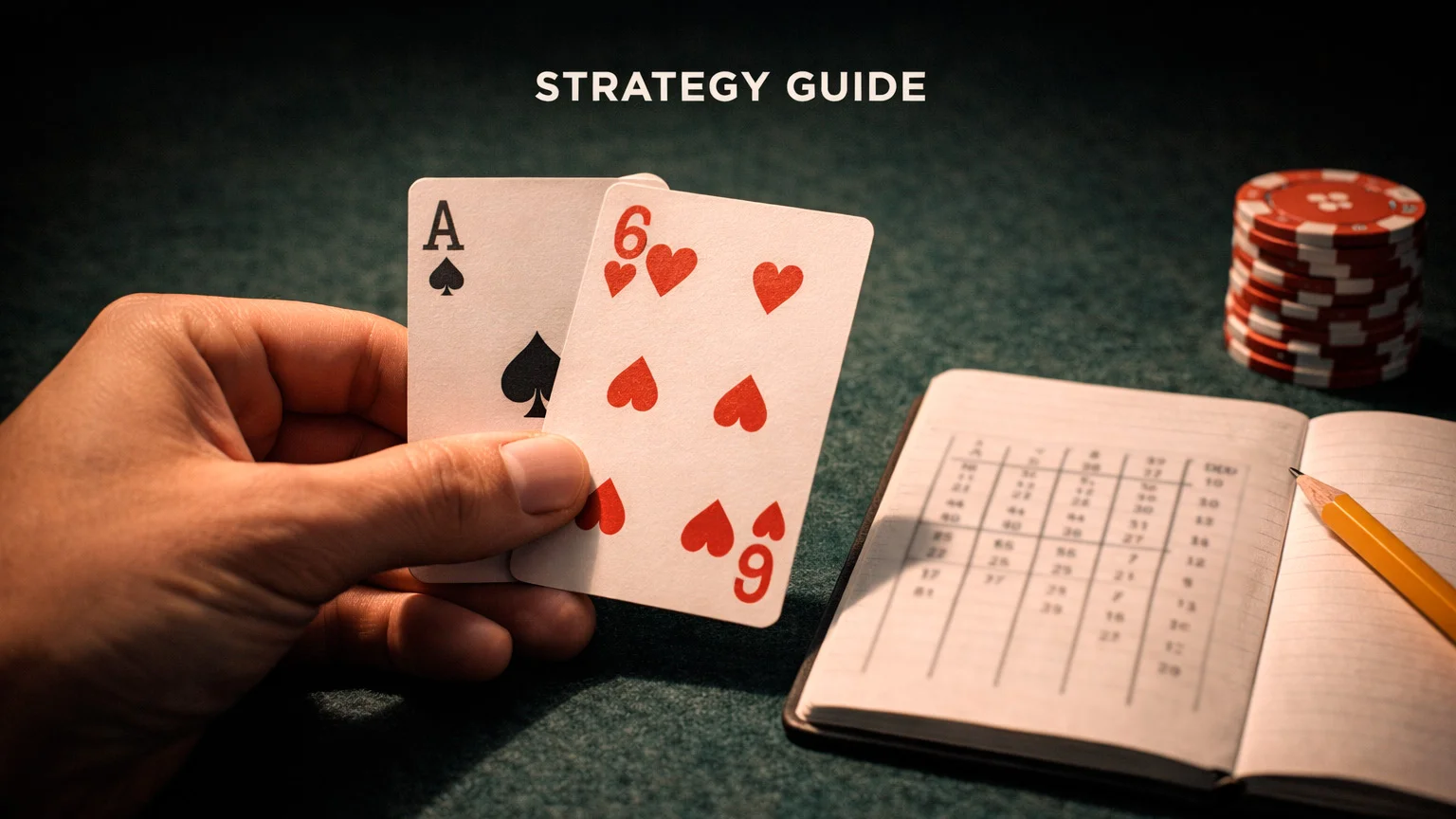
Why Strategy Matters More at Sweepstakes Tables
Sweepstakes blackjack strategy isn’t a different discipline from regular blackjack strategy — the math doesn’t change just because you’re wagering Sweeps Coins instead of dollars. The cards still follow the same probability distributions, the dealer still plays by fixed rules, and every hand still has one correct move. What does change is the context around that math, and the context matters more than most players realize.
At a traditional online or land-based casino, the house edge on blackjack sits between 0.3% and 0.5% when a player uses optimal basic strategy, according to Wizard of Odds. Without any strategy — just playing on instinct — that edge balloons to 2% or higher, effectively quadrupling the casino’s advantage. In a real-money environment, that difference translates directly into dollars lost per hour. In a sweepstakes environment, the same math applies to your Sweeps Coin balance, which carries real redemption value once you meet the platform’s payout threshold.
The argument for disciplined strategy play is actually stronger in the sweepstakes context, not weaker. Many players treat sweepstakes tables as casual entertainment — Gold Coins feel like play money, and even Sweeps Coins don’t trigger the same psychological weight as a $25 chip sitting in a bet circle. That cognitive disconnect leads to sloppy decisions: hitting when you should stand, ignoring basic split opportunities, taking insurance when the math screams otherwise. Every one of those mistakes widens the house edge, and at sweepstakes tables, where session lengths tend to be long and stakes tend to be low, those small mistakes compound across hundreds of hands into significant SC erosion. The sweepstakes market grew at a 60-70% compound annual growth rate between 2020 and 2024, according to KPMG’s gaming industry analysis, which means millions of new players are sitting down at these tables without having thought about strategy at all. That’s good news for the platforms and a preventable problem for the players.
This guide covers sweepstakes blackjack strategy from foundational decisions through advanced play — not because the strategy itself is different, but because the environment in which you’re applying it has specific characteristics that deserve attention. RNG dealing, the absence of shoe penetration, dual-currency considerations, and platform-specific rule variations all shape how strategy performs in practice. If you already know basic strategy cold, the sections on RNG impact and advanced plays will be most useful. If you’re building from the ground up, start at the beginning and treat every hand as what it is: a math problem with one correct answer.
Basic Strategy Decisions: When to Hit, Stand, Split, or Double
Basic strategy is a complete set of rules that tells you the mathematically optimal action for every possible combination of your hand and the dealer’s upcard. It’s not a heuristic, not a guideline, and not a “system” in the way that roulette systems claim to be. It’s the output of running every possible deal through probability calculations and selecting the action that minimizes expected loss (or maximizes expected gain) in each scenario. Learning it is not optional if you care about results.
Hard Hands: The Foundation
A hard hand is any hand without an ace counted as 11, or any hand where the ace has already been forced to count as 1 to avoid busting. These are the most common situations you’ll face, and they’re where new players make the most costly errors.
The critical thresholds are 12, 16, and 17. With a hard total of 8 or below, you always hit — there’s no risk of busting, and standing on a low total is almost never correct. With hard 17 or above, you always stand — the risk of busting outweighs the potential improvement. The contested zone is 12 through 16, and this is where basic strategy earns its keep.
With hard 12, you stand against dealer 4, 5, or 6 (the dealer’s weakest upcards, where they’re most likely to bust) and hit against everything else. With hard 13 through 16, the stand range expands to include dealer 2 and 3. The logic is consistent: when the dealer is showing a card that gives them a high bust probability, you protect your hand by standing even on a weak total. When the dealer is showing a 7 or higher, their chances of making a strong hand are too good, and you need to try to improve even at the risk of going over 21.
The decision that trips up the most players is hard 16 against a dealer 10. Basic strategy says hit, but it feels terrible — you’re likely to bust, and that ten staring at you from across the table feels like a guaranteed loss regardless. The math doesn’t care about feelings. Standing on 16 against a 10 loses more often than hitting does, full stop. At a sweepstakes table where you might play 200 hands in a session, making the wrong call on this specific situation even a third of the time adds measurable cost to your SC balance over time.
Soft Hands: Using the Ace’s Flexibility
A soft hand contains an ace counted as 11. The beauty of soft hands is that you can’t bust by taking one more card — the ace simply reverts to 1 if the new card would push you over 21. This safety net means the correct strategy for soft hands is consistently more aggressive than for equivalent hard totals.
Soft 17 (ace-6) is the hand that separates players who know basic strategy from those who think they do. Many players stand on soft 17 because 17 feels like a decent total. It isn’t. Soft 17 should always be hit (or doubled, depending on the dealer’s upcard and the table rules). Standing on soft 17 is one of the most expensive mistakes in blackjack, because you’re giving up a free chance to improve a mediocre hand with zero risk of busting.
Soft 18 (ace-7) is the other tricky one. Most players stand here without thinking, and against dealer 2, 7, or 8, that’s correct. But against dealer 9, 10, or ace, the right play is to hit. An 18 is not a strong hand against a dealer who’s likely to end up with 19 or 20, and the ace gives you the flexibility to improve without catastrophic downside. Against dealer 3 through 6, double down on soft 18 if the rules allow it — you’re capitalizing on the dealer’s weakness with a hand that has significant upside potential.
Pair Splitting: When Two Becomes Two
Pair splitting decisions follow their own logic within basic strategy. The cardinal rules: always split aces and always split eights. Never split tens and never split fives. Everything else is conditional on the dealer’s upcard.
Splitting aces is obvious once you think about it — each ace becomes the start of a potential 21, and starting a hand with 11 is the strongest possible position. Splitting eights is more counterintuitive to new players, because a total of 16 feels like something you should just hit and hope. But 16 is the worst total in blackjack, while 8 is a reasonable starting point for building toward 18. Splitting eights converts one terrible hand into two decent chances.
Never splitting tens is about greed management: 20 is the second-best hand in blackjack, and breaking it up to try for two potentially worse hands is negative expected value in almost every scenario. Never splitting fives follows the same logic — a total of 10 is a strong doubling candidate, and splitting it into two hands starting with 5 gives you two weak positions instead of one strong one.
Doubling Down: Maximizing Good Situations
Doubling allows you to place an additional bet equal to your original wager in exchange for receiving exactly one more card. The strategy here is straightforward: you double when the math says your expected return on two units exceeds the expected return on one unit played normally.
The highest-value doubles are on hard 11 (double against everything except dealer ace), hard 10 (double against dealer 2 through 9), and hard 9 (double against dealer 3 through 6). Soft hand doubles extend the range further — soft 13 through 17 against dealer 4, 5, or 6 are all positive double opportunities in most rule sets.
Here’s where rule awareness becomes critical for sweepstakes players: not all platforms allow doubling on every two-card total. Some restrict doubles to 9, 10, and 11 only. Others prohibit doubling after a split. According to Vegas Insider’s analysis of rule-dependent house edge variation, a double-deck game with liberal rules (dealer stands on all 17s, double on any two cards) carries a house edge around 0.25%, while the same game with restrictive rules (dealer hits soft 17, double on 10/11 only) pushes the house edge to roughly 0.7%. That’s nearly a threefold increase from rule changes alone, before any player errors enter the picture. On a sweepstakes platform, you need to check which doubling rules apply at your specific table before assuming the standard strategy chart is fully applicable.
How RNG Changes the Math vs. Shoe-Dealt Games
Every hand at a sweepstakes blackjack table is dealt by a random number generator, and this single fact reshapes the strategic landscape in ways that aren’t immediately obvious. At a physical casino or a live dealer table, cards come from a finite shoe — typically six or eight decks shuffled together. As cards are dealt, the composition of the remaining shoe changes. A shoe that’s had a disproportionate number of low cards dealt becomes richer in high cards, which shifts the probabilities of future hands in ways that a knowledgeable player can exploit, at least in theory.
RNG blackjack eliminates that dynamic entirely. Each hand is dealt from a freshly shuffled virtual deck or shoe, which means the probability distribution resets before every deal. The ten of spades that appeared on the last hand is just as likely to appear on the next one. There’s no “hot deck” or “cold deck” in any meaningful sense, because the concept of deck composition tracking doesn’t apply to a system that simulates a perfect shuffle between every hand.
For basic strategy, this is actually neutral-to-positive news. Basic strategy is calculated assuming a full, unbiased deck, which is exactly what an RNG provides. The strategy chart on your screen or taped to your monitor is more precisely applicable to an RNG game than to a half-depleted shoe at a physical table, where the “correct” move can theoretically shift based on the cards already dealt. In practice, the basic strategy deviations caused by shoe composition are small enough that most players would never notice them, but the point stands: RNG dealing and basic strategy are a cleaner mathematical match than shoe dealing and basic strategy.
Where RNG changes the practical equation is in variance. In a shoe game, short-term streaks can sometimes be partially explained by deck composition — a run of face cards from a 10-rich shoe, for instance. In an RNG game, streaks are pure randomness, and they can be more extreme than intuition suggests. Players who don’t understand this may interpret a bad stretch as evidence that the RNG is “rigged” or a good stretch as evidence that they’ve found a pattern. Neither is accurate. The RNG produces outcomes that, over a large sample, converge on the expected probabilities — but any given session can deviate significantly from the mean.
As Magnus Boberg, founder of JustGamblers, explained when discussing the structural differences between sweepstakes and traditional platforms: “Traditional gambling requires three elements: consideration, chance, and prize. Sweepstakes sites do not require payment, so they bypass regulations that apply to traditional online gambling.” — Magnus Boberg, Founder, JustGamblers. That structural bypass extends to the technical layer: sweepstakes RNG implementations are not subject to the same third-party testing requirements that regulated online casinos must meet in jurisdictions like New Jersey or Michigan. Some platforms voluntarily submit to testing, and others offer provably fair verification, but neither is mandatory across the industry.
The practical implication for strategy players is this: basic strategy works exactly as well at an RNG table as it does anywhere else, provided the RNG is fair. Your job as a player is to apply strategy consistently and to select platforms where you have reason to believe the RNG is operating correctly — through published RTP data, provably fair verification, or the reputational weight of the platform. Compared to other casino games, the advantage of knowing optimal play is substantial. Wizard of Odds data shows that slots carry a house edge of 2% to 15%, roulette ranges from 2.7% (European) to 5.26% (American), and baccarat sits around 1.06% on banker bets. Blackjack with basic strategy undercuts all of them, making it the best mathematical bet available at any sweepstakes casino that offers table games.
Can You Count Cards at a Sweepstakes Casino?
No. The short answer is the complete answer, but the reasoning behind it matters for understanding why certain strategies that work in physical casinos are structurally impossible in the sweepstakes environment.
Card counting works by tracking the ratio of high cards to low cards remaining in a shoe. When the remaining deck is disproportionately rich in tens and aces, the player has a statistical advantage: they’re more likely to be dealt naturals (which pay 3:2), and the dealer is more likely to bust on stiff hands. Card counters exploit this by increasing their bets when the count is favorable and reducing them when it’s not. Over thousands of hands, this bet-sizing adjustment can flip the house edge into a slight player edge — typically 0.5% to 1.5%, depending on the count system and the game conditions.
Every element of that advantage depends on one assumption: the deck composition changes as cards are dealt, and those changes carry forward into future hands. At a sweepstakes casino, the RNG resets the deck before every hand. There is no running composition to track, no depleted shoe to exploit, and no meaningful count to maintain. The “count” after every hand is always the same: a full, neutral deck. It’s like trying to predict the next flip of a fair coin based on the previous flip — the events are independent, and no amount of tracking changes the underlying probability.
This isn’t a limitation of card counting technique; it’s a structural feature of how RNG dealing works. Even the most sophisticated counting system — whether it’s Hi-Lo, Omega II, Wong Halves, or anything else — produces zero value when applied to a game with independent trials. You’d get exactly the same edge by ignoring the count entirely and playing flat basic strategy, which is to say: the house edge stays at 0.3% to 0.5%, and no betting adjustment can reduce it further.
Some players ask whether a modified form of counting could work — tracking patterns, looking for RNG “tendencies,” or testing whether certain outcomes cluster in ways that suggest the random number generator isn’t truly random. This falls into the category of gambler’s fallacy with extra steps. A properly functioning RNG doesn’t produce patterns that are exploitable, and if it did, the flaw wouldn’t be detectable through casual observation at the table. Professional RNG testing involves statistical analysis across millions of outcomes. If you’ve found a pattern in 200 hands, you’ve found noise, not signal.
The irony is that the impossibility of card counting at sweepstakes tables actually simplifies your strategic task. Without any counting edge to pursue, there’s no need to vary your bet sizes based on perceived deck conditions. Flat betting combined with perfect basic strategy is the provably optimal approach at any RNG blackjack table. Without strategy, the house edge can reach 2% or more, according to Wizard of Odds. With strategy, you’re playing one of the lowest house-edge games available on any sweepstakes platform. The gap between those two numbers is entirely within your control — which makes mastering the basic strategy chart a far better use of your time than trying to resurrect a counting technique that was designed for a fundamentally different dealing environment.
Advanced Plays: Soft Hands, Insurance, and Surrender
Once you’ve internalized the core decisions — when to hit, stand, split, and double — the remaining strategic ground covers situations that arise less frequently but carry outsized impact when they do. These are the plays that separate a player who knows basic strategy from a player who applies it completely.
Soft Hand Doubles Revisited
We covered soft hand strategy in the basics section, but doubling on soft hands deserves a closer look because it’s the area where sweepstakes platform rule variations create the most variance. On a standard table with liberal rules, you should double on soft 13 through 17 against dealer 5 and 6, extend to dealer 4 for soft 15 through 17, and push further for soft 16 and 17 against dealer 3. Soft 18 doubles against dealer 3 through 6.
The catch is that several sweepstakes blackjack tables restrict doubling to hard totals of 9, 10, or 11 only. When soft doubles are off the table, the correct play shifts to hitting instead, which is still positive EV but captures less value from favorable situations. Before you sit down at any sweepstakes table and commit SC to a session, check the rules panel for doubling restrictions. The difference between a table that allows soft doubles and one that doesn’t is a tangible shift in expected return, and it should factor into which platform and which variant you choose to play.
Insurance: The Bet That Isn’t a Bet
When the dealer shows an ace, most blackjack tables offer insurance — a side wager at 2:1 that the dealer’s hole card is a ten-value, completing a blackjack. Insurance costs half your original bet, and if the dealer does have blackjack, you receive a 2:1 payout on the insurance bet while losing your original wager. The net effect is that you break even on the hand.
The correct basic strategy play is to decline insurance every time, without exception. This is one of the few areas of basic strategy where the math is unambiguous and the answer never changes regardless of rule variations, deck count, or platform. In a standard deck, roughly 30.8% of cards are ten-values (tens, jacks, queens, kings). For insurance to be a breakeven bet, the probability of the dealer having a ten in the hole would need to be 33.3%. Since 30.8% is less than 33.3%, insurance is a net negative bet — always, in every configuration, at every sweepstakes table that exists.
The only scenario where insurance becomes mathematically sound is when the remaining deck is unusually rich in tens — which is exactly the situation card counters exploit at shoe-dealt tables. At a sweepstakes table, where the RNG deals from a fresh deck every hand, that condition can never be confirmed. Insurance at an RNG table is a pure house-edge bet disguised as risk management, and accepting it over the course of a session adds approximately 7% house edge on the insurance wager itself. Just say no.
Surrender: Cutting Losses When the Math Says To
Surrender is the blackjack equivalent of folding a bad hand in poker — you forfeit half your bet and exit the hand immediately. Not all sweepstakes tables offer surrender, but when it’s available, it’s a powerful tool for minimizing losses in the worst situations.
The basic strategy surrender plays are narrow and specific. With hard 16 (but not 8-8) against a dealer 9, 10, or ace: surrender. With hard 15 against a dealer 10: surrender. That’s essentially the complete list for standard games. Some rule sets extend surrender options to additional totals, but the core situations are hands where you’re a significant statistical underdog and where half a bet saved now exceeds the expected value of playing the hand out.
Players who’ve never used surrender often resist it on psychological grounds — it feels like quitting, and nobody likes handing back half a bet. But the math on hard 16 against a dealer 10 is brutal. You’ll lose approximately 77% of the time if you play the hand, regardless of whether you hit or stand. Surrendering recovers 50% of your bet instead of losing the expected ~77%. Over hundreds of hands, the cumulative value of surrendering in the correct spots is significant — it doesn’t swing the overall house edge dramatically, but it shaves off enough to matter for any player tracking their SC balance across sessions.
Even-Money on Blackjack vs. Dealer Ace
When you’re dealt a natural 21 and the dealer shows an ace, some tables offer “even money” — a guaranteed 1:1 payout instead of the standard 3:2, regardless of whether the dealer also has blackjack. This is mathematically identical to taking insurance on a blackjack hand, and the correct play is the same: decline it.
The temptation is strong, because even money feels like locking in a sure win instead of risking a push. But the expected value calculation favors declining. With a 30.8% chance that the dealer has blackjack (resulting in a push and no payout), your expected return from declining even money is 1.038 units — higher than the 1.0 units guaranteed by taking it. You’ll push roughly three out of ten times, which stings when it happens, but the other seven times you collect 1.5 units instead of 1.0. Over a large sample, declining even money returns more than accepting it.
Putting It All Together
The complete strategic picture for sweepstakes blackjack isn’t complicated — it’s just thorough. Every hand has one correct move, and the discipline required to make that move consistently, hand after hand, session after session, is what separates players who maintain their SC balance from those who wonder why it erodes despite “playing well.” The platform you choose affects the rule set you play under, which shifts exact EV calculations. The RNG ensures that counting is irrelevant, which simplifies the task to pure decision-making. And the dual-currency environment means that every correctly played hand preserves real, redeemable value — even if the coins on screen don’t feel like dollars until you hit the cashout button. Strategy isn’t a suggestion at sweepstakes tables. It’s the entire difference between the lowest house edge in any sweepstakes game and the kind of edge that makes the platform’s business model work.
The wider context is set out in our sweepstakes blackjack guide.
Side bets are where strategy stops: blackjack side bets.